EDUCATION: Miramar College Investing $48M to Meet Aviation Workforce Demand
By Madison Geering | August 31, 2026
Miramar College has an auxiliary aviation center at Montgomery Field which will undergo a $48 million transformation as a part of the San Diego Community College District’s $3.5 billion bond Measure HH.
SAN DIEGO – Before Miramar College was founded in 1969, its footprint was home to the World War II era airfield Linda Vista Mesa Field. During the war, it was primarily used for carrier landing practice. Today, the site is home to Miramar College’s Aviation Operations Program, which offers education and workforce training in piloting, air traffic control, aeronautics and more.
The college also has an auxiliary aviation center at Montgomery-Gibbs Airport which will undergo a $48 million transformation as a part of the San Diego Community College District’s (SDCCD) $3.5 billion bond Measure HH.
Miramar College President Wesley Lundberg said the project will further enable the school to meet rising workforce demand in aviation. “It’s a real feel-good thing for the community, to know that their dollars they approved on that bond project are enabling us to move forward with [developing] a flight school and air traffic control education, as well as improving the program in general for aviation,” Lundberg said. While it has experienced major growth in the last few years, Miramar College’s aviation program has always aimed to make an impact. Professor Paul Chlapecka has taught in the department for over 39 years. “We’ve had students that come from many different walks of life. We have professionals. We have attorneys. We have physicians,” Chlapecka said. “We’ve also had people who didn’t have an opportunity for a career. They had nothing when they came here, and I’m fortunate because I’ve managed to change a few lives.”
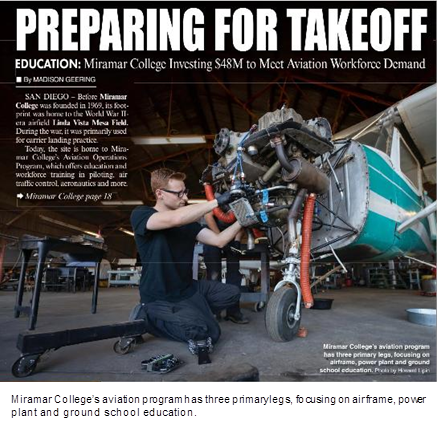
Miramar College’s aviation program has three major legs:
- Airframe: Focuses on the mechanical structure of the plane.
- Power Plant: Focuses on the plane’s engine.
- Ground School: Teaches students everything they can learn about being a pilot from the ground.
The school offers a range of certificates and degrees preparing students for various careers in aviation. Chlapecka explained that not all students follow a traditional path. Miramar College aims to support them by providing accessible, high-quality education and a pipeline into a high-demand industry.
“We’ve had people with no experience whatsoever in aviation, and they’re working in industry now,” he said. “I think we gave them that spark of interest.”
Lundberg said that air traffic controllers are currently highly wanted in the market. In response, Miramar College is launching its Enhanced FAA Air Traffic Control program. So far, the college is offering a few courses with plans for a full rollout in Fall 2028.
Until October 2024, to become an air traffic controller, students’ only option was to go through the FAA’s academy in Oklahoma City. “The FAA is realizing they can’t keep up with the demand, and they never will,” Lundberg said. “So, they’re making it possible for other institutions to distribute that education.” Miramar College is the second college in California launching the program. Lundberg said that air traffic control jobs are desirable because students can theoretically obtain certification withing a year and make over $100,000 in salary.
Strong industry partnerships with airlines like Delta, Alaska and Hawaiian allow Miramar College to offer internships and employment opportunities to students. The college also has several flight simulators onsite, providing aspiring pilots with a cost-effective training option.
Tarynne Mingione has been a part-time student at Miramar College for several years. She works as a private pilot and has a separate career in medical device sales. Mingione enrolled in Miramar College’s program because she wanted to learn more about the mechanical side of aviation in addition to the operational side.
Because of her experience in the program, she said she’s considering a more complete pivot into aviation. Since less than 6% of pilots are women, according to industry data from Rotate, Mingione added that the programming has been especially empowering.
“I think this is a hidden gem,” she said. “This is one of the biggest reasons I stay in San Diego — this program, exposure to this facility, this equipment, these instructors and their expertise. Having that community here, I don’t know where else you would find it.”
Expansion Under Measure HH.
Miramar College’s aviation program has a long waitlist, Lundberg said. According to a 2025 study by the Center of Excellence for Labor Market Research, air traffic controllers, avionics technicians, aircraft mechanics, commercial pilots and flight attendants were identified in San Diego’s top 50 priority jobs.
That demand is part of why the college’s facilities at Montgomery Field are being expanded under Measure HH.
The Miramar College Montgomery Field Instructional Center Project includes the demolition of the existing 6,300-square-foot hangar and construction of about 18,000 total square feet of new space supporting expanded aviation workforce training.
The renovated facility will include modern technology; climate control; advanced training equipment; new site utilities; exterior walkways; accessible parking and pathways; curb and gutter improvements; and landscaping and signage.
The new center is expected to open in Fall 2027. Its general contractor is San Diego-based Harper Construction Company and its architect is San Diego-based Cass Sowatsky Consulting Architects (CSCA).
Without Measure HH, it would be much harder to complete this kind of project, Lundberg said. Funding from the bond measure will be transformational to the program.
While Measure HH will cover the buildout of physical center, correlated staffing must be supported by SDCCD’s state budget. One-time financial support is helpful but doesn’t support long-term infrastructure, Lundberg said.
“When we create a contract position, a fulltime position, we’re married to that for life,” he said. “So one-time funding doesn’t help us with that. We have to have state funding.”
Lundberg explained that community colleges are often the lowest priority for California state funding, after University of California, California State University and K-12 schools.
“But if you look at the biggest impact on economic development and maintenance, community colleges contribute directly to that,” Lundberg said. “We’re putting people right into the workforce — auto tech, radiology. You name it, we community colleges do it.”
Philanthropic giving has been and will always be integral to community colleges, Lundberg said. Making the community aware of the colleges’ impact and needs is a priority.
Empowering Students, Increasing Accessibility.
To become a private pilot, students must complete at least 40 hours of flight time. That number increases for a commercial pilot license and airline transport pilot certification.
While students can complete some training with Miramar College’s simulators, many of their hours must be completed in-flight, which can get costly.
“It can cost each student about $60,000 because of how many hours they have to be up there in the planes. You can only fit one student and one instructor in a plane,” Lundberg said. “So, every hour they’re paying that person’s full amount. If we get that internal, then it really slashes the cost.”
By developing its own in-flight school, Lundberg estimated that Miramar College could take in-flight costs per student from about $60,000 to around $2,000.
“If you think about equal access to education, that’s really what we’re all about,” Lundberg said. “Think about what $60,000 does for someone from Southeast San Diego. It’s unreachable.”
When Lundberg was in ninth grade, a guidance counselor told him he wasn’t “college material.” He said he took that to heart and didn’t initially pursue higher education.
“When I graduated, I was working for a janitorial company, and they were moving me up very quickly,” he recalled. “But I remember standing in an office checking on my employees, making sure they cleaned. It was 2 a.m. In my pickup truck, I had two shoeboxes full of keys. I was looking at this garbage can full of Bartles & Jaymes wine coolers, thinking of the disparity between a janitor and the people they clean up after. I thought, ‘I don’t want to do this the rest of my life.’”
The next week, Lundberg enrolled at Fresno City College. There, he had many professors that encouraged and supported him. He went on to earn several degrees and spend a decades-long career in higher education.
As Lundberg prepares to retire from Miramar College next July, he reflected on the power that educators have over students’ lives. By expanding its aviation programming, he hopes that the college can change many more.
Image